
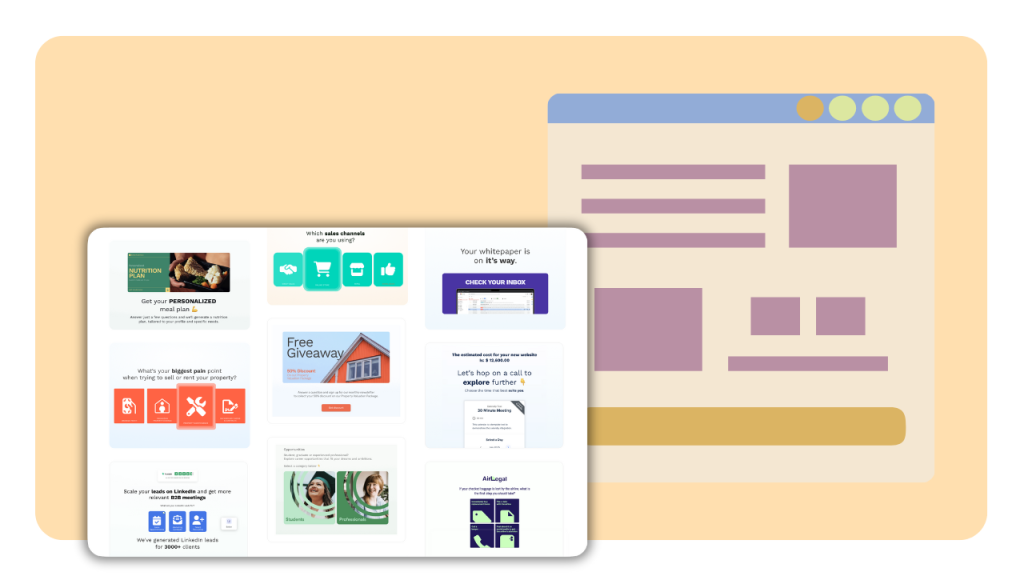
Crafting an effective B2B landing page can be challenging, business buyers are a tough crowd. Unlike consumer pages, B2B pages often contend with longer sales cycles, multiple decision-makers, and complex offerings.
It’s no surprise that B2B landing pages typically see lower conversion rates (often in the 1–3% range on average compared to B2C pages. The upside? With smart design and messaging, even a small lift in conversion can mean significant business impact.
In this article, we’ll highlight some of the best B2B landing page examples across industries, from tech and SaaS to finance and services.
For each example, we’ll break down what makes it effective: from powerful headlines and layouts to strong calls-to-action (CTAs) and trust signals. Whether you’re a marketer, SaaS founder, or small business owner, these examples and tips will help you turn more visitors into leads and customers. Let’s dive in!
What is a B2B Landing Page?
A B2B landing page is a standalone, campaign-specific web page created for a marketing or advertising campaign, where a business prospect “lands” after clicking an ad, email link, or social post.
Unlike a general webpage, a landing page is designed with a single focused goal (CTA) in mind, such as getting the visitor to fill out a form, download a resource, or request a demo. Everything on the page, from the headline to the images and copy, is meant to keep the visitor focused on that one action without distractions. In a B2B context, the goal is usually to capture a lead or move a potential business customer further down the sales funnel.
How is a B2B Landing Page Different from B2C?
While the core principles of good landing pages apply to both, B2B landing pages differ from B2C in a few key ways. First, B2B offerings typically involve longer sales cycles and multiple decision-makers, so the landing page often needs to provide more information and build more trust upfront.
The conversion action on a B2B page is usually not an immediate purchase (as it might be in B2C); instead it could be something like “Schedule a Demo” or “Get a Quote,” which is the start of a longer conversation. B2B pages may emphasize return on investment (ROI), case studies, and detailed benefits since business buyers are usually evaluating for value and fit. In contrast, B2C landing pages (e.g. for an online store) might focus on emotional appeal, quick specials, or impulse buys. Also, B2B pages tend to have lower average conversion rates (often just a few percent) because of the higher stakes and friction, for example, a form fill on a B2B page is the beginning of a sales process, whereas a B2C page might convert a sale on the spot.
Outstanding B2B Landing Page Examples
ActiveCampaign: Solving the Customer’s Problem Up Front
ActiveCampaign (a marketing automation SaaS) grabs attention by immediately addressing the visitor’s pain point. The landing page headline reads “Put the right emails in front of the right people,” speaking directly to what the target audience cares about, email personalization.
Notice it doesn’t focus on features of the platform; instead, it promises to solve a specific problem for the customer. This customer-centric messaging tells prospects they’re in the right place, which is crucial given you have under 15 seconds to hook a visitor’s attention.
The lesson here: lead with a clear value proposition that mirrors your audience’s top priority. By doing so, ActiveCampaign’s page makes an immediate connection with prospects and guides them toward the call-to-action confidently.

Shopify: Reducing Friction with a Single-Field Form
Shopify’s B2B landing page (for its free trial) exemplifies “less is more” when it comes to forms. Rather than overwhelm visitors with a long form asking for name, phone, company size, etc., Shopify keeps it dead simple, just one field for an email address to get started.
This minimal approach removes nearly all friction from the sign-up process. It’s effective because each additional form field can drastically reduce conversions. (In one study, cutting a form from 11 fields to 4 boosted conversions by 120%.)
Shopify knows there will be time later in the sales process to collect more info; the landing page’s job is simply to get the visitor through the first door. The takeaway: if you can, start with an easy first step, you’ll capture more leads by not scaring them off with a daunting form upfront.

Monday.com: Building Trust by Association
Project management platform Monday.com uses a clever trust-building tactic on its landing page, it name-drops a complementary brand. In one example, Monday’s page prominently mentions and even shows Slack (a widely recognized workplace chat tool), highlighting that Monday integrates with Slack.
This does two things: first, it taps into the familiarity and credibility of Slack’s brand to assure visitors (basically saying, “don’t worry, we play nicely with tools you already trust”). Second, it subtly suggests that if you use Slack, Monday will fit right into your workflow. Monday still touts its own benefits (like improved project collaboration), but by “wrapping its arms around” another trusted service, it doubles the credibility factor.
The best practice here is leveraging partnerships or integrations as social proof. Seeing a beloved brand on the page can instantly make a prospect more comfortable converting.

Salesforce: Leading with Impressive Data
Salesforce, a giant in B2B CRM, proves that sometimes hard numbers do the talking. One of their landing pages aimed at a specific region strips away flashy design and instead puts bold statistics front and center. For example, it states: “Customers have achieved +37% increase in sales, +45% in customer satisfaction, and +43% in marketing ROI” after using Salesforce.
Those eye-catching stats immediately communicate real business impact. The headline drives it home: “Grow Your Business with the World’s #1 Business CRM.” By leading with concrete results and an authoritative claim, Salesforce appeals to the logical side of B2B buyers who often need proof and ROI evidence.
The minimalistic layout (no clutter, just a hero statement and a few bullets of proof) highlights the message that Salesforce delivers results, and that’s a compelling pitch. Data-driven social proof like this can be incredibly persuasive on B2B pages, where decision-makers want to justify their choice with facts.

PaystubHero: Simplicity and Trust for Small Business
PaystubHero (a B2B payroll tool for small businesses) offers a textbook example of balancing simplicity with credibility. The headline immediately promises the core value – making payroll “simple and stress-free.” The supporting text reinforces ease-of-use, which resonates with busy entrepreneurs who dread complicated software.
Visually, the page is clean with a single prominent CTA button (contrasting color to draw the eye) inviting users to get started. But simplicity alone isn’t enough in the finance world, trust is paramount.
PaystubHero’s page features trust badges and customer testimonials that signal the service is credible and widely used. It even reassures visitors that the generated pay stubs are IRS-compliant, addressing a key concern upfront. By keeping the design uncluttered and the copy focused on quick, accurate results, PaystubHero speaks to its audience’s needs. The result is a landing page that feels both easy and safe, exactly what a small business owner wants from a financial tool.

Slack: Repositioning the Value Proposition
Everyone knows Slack as a workplace chat app, but Slack’s landing page shows how you can reposition your product to change perceptions. The page boldly declares a new identity: “Slack is where work happens.” In the span of a few scrolls, Slack reframes itself from just a messaging tool to a full-fledged “collaboration hub” for businesses.
The copy talks about creating channels for every conversation and quickly finding what you need, painting Slack as the central nervous system of a company’s work. This approach can actually expand the appeal of the product by elevating its perceived importance. Importantly, Slack’s page doesn’t just make claims; it backs up the new positioning with strong social proof and case studies from real customers.
Seeing recognizable logos and reading success stories helps visitors trust the repositioning. In essence, the page is educating prospects: “Slack isn’t just for chatting memes, it’s mission-critical software for your organization.” The conversational yet confident tone invites the reader to envision a more productive workplace with Slack at the center. It’s a masterclass in using landing page content to change how your audience thinks about your solution (and why they need it).

Intercom: Catering to Different Buyer Journeys
Conventional wisdom says a landing page should have one single CTA and no external links, but Intercom shows that in B2B, sometimes you have to break the rules (carefully). Intercom’s landing page centers on a primary CTA (“Start your free trial”), yet it also provides additional buttons that let visitors explore more about specific use cases: e.g. how to use Intercom to acquire customers, or to support customers.
Each of those buttons leads to a deeper page on that topic. At first glance, offering multiple paths could distract from the main conversion goal. However, Intercom recognized that not all visitors are ready to jump in immediately. Some might need to educate themselves more, especially for a multifaceted platform like Intercom. By catering to both intent levels (ready-to-trial vs. researching), the page serves a dual purpose. This strategy acknowledges that B2B buyers often seek more information before converting.
It’s a calculated risk that, when done right, can increase overall conversions: those who are hot prospects can take the main CTA, while others can self-segment and get the info they need, then convert later. The key is to keep these options clearly organized, as Intercom does, so the user isn’t overwhelmed. It’s a great example of putting the user’s needs first, even if it means adding a few extra links.

Blink (UX Agency): Packing Social Proof to Build Credibility
Blink, a UX consulting agency, approaches its landing page like a case study in social proof. Instead of just one token testimonial, Blink piles on three layers of trust signals for maximum impact. First, at the top, they display a logo bar of heavyweight clients they’ve served, Google, Amazon, Starbucks, NASA, and more.
Seeing those logos immediately tells the visitor, “If brands like these trust Blink, you can too.” Next, the page features glowing testimonials from satisfied clients, giving qualitative praise to back up the logos.
Finally, Blink showcases industry awards and accolades they’ve earned over the years. This one-two-three punch of logos, quotes, and awards creates a powerful “bandwagon effect,” where visitors feel that everyone (including industry leaders) endorses Blink’s expertise.
It’s hard to argue with that kind of credibility. Considering about 77% of marketers omit social proof on their landing pages (even though adding a single testimonial can increase conversions ~34%), Blink’s strategy of leveraging multiple proof points really sets them apart. The page essentially shouts, “We’re trusted and proven,” which can seriously lower a prospect’s guard. If your product or service is one that buyers might hesitate to adopt, take a page from Blink and let your successes and happy customers do the selling.

What Are Must-have Elements of a Successful B2B Landing Page?
Successful B2B landing pages usually include several must have elements to maximize their effectiveness:
A Clear, Compelling Headline
Your headline should immediately grab attention and speak to the visitor’s need or pain point. It must convey the core value proposition in one punchy sentence. (For example, ActiveCampaign’s “Put the right emails in front of the right people” tells you exactly the benefit on offer.)
Strong Visual or Hero Image
An eye-catching hero image, graphic, or even video that reinforces the message. Visuals help engagement, people remember 80% of what they see vs. 20% of what they read. Whether it’s a product screenshot or a photo illustrating the solution, make sure it’s relevant and high-quality.
Focused Call-to-Action (CTA)
A prominent CTA button or form that clearly tells visitors what to do next (e.g., “Get My Free Demo” or “Download the Guide”). The CTA should stand out on the page. Avoid generic phrases like “Submit” – specific, benefit-oriented text tends to perform better (a generic “Submit” can hurt conversions by ~3%).
Minimal Distractions (No Extra Navigation)
Unlike a full website, a landing page should remove navigation menus and external links that could lead visitors astray. The idea is to keep them focused on the offer. Many high-converting pages even remove the header navigation entirely, presenting only the content related to the campaign and a CTA.
Social Proof
Include testimonials, client logos, case study snippets, or trust badges. B2B buyers look for signals that other companies have had success with your solution. For instance, a brief quote from a happy customer or a list of well-known client logos can significantly boost credibility. Only about 1 in 4 marketers use testimonials on their landing pages, yet 37% of top-performing pages do, and adding a testimonial can increase conversions by 34% in some cases. In short, don’t skip this element, even a single compelling quote can make a difference.
Trust Signals and Details
Beyond testimonials, consider any other trust enhancers appropriate to your offer. This could be security badges (important if you’re asking for data), industry awards, media mentions, or guarantees (like “Money-back guarantee” or “No credit card required for trial”). Also, providing contact information (a phone number or chat option) can reassure visitors that there are real people behind the page, increasing trust.
Concise, Benefit-Oriented Copy
The body of your landing page should outline what you’re offering and why it’s valuable in a concise way. Use bullet points or short sections to highlight key benefits or features. Remember, visitors often skim. Breaking up text with subheadings or icons (as we saw with GCC’s use of iconography) makes it easier to digest.
Aim to answer the visitor’s unspoken questions: “What is this? How will it help me? Why should I choose this over others?” (Salesflare’s Q&A-style copy is a good example of anticipating questions.)
Mobile-Friendly Design
Ensure your layout is responsive. As of 2026, a vast majority of landing page traffic (over 80%) can come from mobile devices. A successful B2B page must look and work great on phones and tablets – that means fast load times, easy-to-read text, and buttons that are thumb-friendly. Mobile-optimized pages actually have slightly higher average conversion rates than desktop-only pages in some analyses. In practice: use large fonts, keep form fields to a minimum (especially on mobile), and test the page on a smartphone to see that everything flows.
A Single Purpose (and Matching Message)
Finally, everything on the page should align with one goal and one message. If your campaign is about getting webinar sign-ups, for example, every element, the headline, copy, image, CTA, should drive that objective. Maintain a message match with your ad or email that brought the visitor here, so they feel continuity (“I clicked an ad about saving time, and this page is clearly about a time-saving solution”). A focused, relevant landing page keeps visitors on track to convert.
How Can I Improve the Conversion Rate of My B2B Landing Page?
Improving conversion rates is all about continuous optimization and understanding your audience. Here are a few strategies:
A/B Test Key Elements: Run experiments on one element at a time, such as the headline, CTA text, form length, or hero image. Even small tweaks can yield big results. For example, simply changing a few words in a CTA led to a 104% conversion lift for one company.
Reduce Friction: Look at your form and page for anything that might be hindering conversions. Can you remove unnecessary form fields? Can the copy be tightened or broken into bullets for clarity?
Increase Trust and Clarity: If your conversion rate is lagging, it might be because visitors have unanswered questions or doubts. Try adding an FAQ section on the page (address common objections), include a testimonial or two if you haven’t already, or highlight a compelling statistic about your results (as Salesforce did).
Align with Your Audience’s Stage: Consider where your typical visitor is in the buying process. If they’re very early-stage, pushing a “Buy Now” might be premature, a softer CTA like “Download Guide” or “Watch Demo” could convert better and still move them forward.
Personalize Where Possible: Use dynamic content to make the page more relevant to each visitor. This could be as simple as swapping out the product name in the headline to match the user’s search query or showing different imagery for different industries.
Use Analytics & Feedback: Dive into your page metrics, where are people clicking, how far are they scrolling, where do they drop off? Tools like heatmaps or session recordings can reveal if users are missing your CTA or getting hung up on a particular section. Also, if possible, gather feedback from users or sales reps: Do prospects find the page informative? Any common objections coming up that the page could address? Continuous feedback loops will guide you to the most impactful improvements.
Bringing It All Together and Next Steps
As we’ve seen, high-converting B2B landing pages come in many flavors, short or long, flashy or plain, but they all put the visitor’s needs first. By studying the examples above, a few consistent themes emerge. A strong B2B landing page zeroes in on a single goal and removes distractions. It speaks to the visitor’s pain points and aspirations in their language, whether through a compelling headline or relatable copy. It builds trust using evidence like testimonials, client logos, or statistics. And it provides a clear, easy path to conversion, be it a one-field form or a well-placed CTA button.
Importantly, great landing pages aren’t one-offs; they’re tested and iterated. If something as small as a three-word change can boost conversions by 104% in an A/B test, you can imagine the impact of continually refining your pages. The reward for all this effort? More qualified leads, more engagements, and ultimately more sales in your pipeline.
Now, feeling inspired to create or improve your own B2B landing pages? This is where involve.me comes in. involve.me, the AI quiz funnel builder with built-in email automation, lets you build high-converting, mobile-friendly landing pages with ease, then automatically follow up with every lead.
You don’t need to be a designer or developer, its drag-and-drop builder and 350+ templates make it simple to implement the best practices we’ve discussed.
Get Started with Landing Pages
Using One Of Our 300+ Templates

B2B Lead Magnet Template

B2B Product Finder Template

B2C Lead Magnet Template
You can quickly test different headlines, embed videos, add quizzes or forms, all without coding. In short, it’s a B2B landing page solution designed to help you engage your audience and capture more leads.
Don’t let your hard-won traffic slip away due to an underperforming page. Take the next step and try involve.me to build your own winning B2B landing page today. With the right tools and strategies, you’ll be well on your way to joining the ranks of these “best of the best” examples, and maybe even surpassing them.
Create a landing page in minutes
No coding, no hassle, just better conversions.
Sources: