


AI Landing Page Generator
With Built-in Email Automation
Generate landing pages with AI, qualify visitors with embedded quizzes, forms, and calculators, and automatically send personalized email sequences to every lead.


Your landing page builder, email automation and CRM in one subscription

Chat with the AI Agent to build & optimize landing pages in seconds
Describe the campaign and the AI Agent builds the landing page: copy, design, embedded form or quiz, scoring rules, and outcome pages. Refine any part with a follow-up prompt. No learning curve, no coding.
Learn more about our AI Agent
Connect the landing page directly to the follow-up journey
Most landing page builders capture a lead and hand them off. involve.me automatically sends personalized email sequences. Sequences branch on answers, scores, outcomes, opens, and clicks, all in one subscription. No separate email tool required.
Learn more about email automation
Send qualified lead data to the tools you already use
55+ native integrations, including HubSpot, Salesforce, ActiveCampaign, Brevo, Mailchimp, Klaviyo, and Pipedrive. Every lead arrives with their answers, score, and segment attached. Zapier and webhooks handle the rest.
Discover all our integrations
Score, segment, and route every visitor
Lead scoring routes each visitor to the right next step, from a consultation booking to a product recommendation. Conditional logic, logic jumps, and OTP verification block junk submissions and qualify every lead before sales sees them.
Learn more about lead qualification
Built-in CRM, not just a response table
Manage leads with a built-in CRM. Every landing page submission creates a contact record with mapped properties, scores, and answers attached. Filter, tag, build dynamic segments, and trigger email sequences directly from the contact view.
Discover the CRM
Collect payments securely without leaving the landing page
Accept payments inside any landing page with native Stripe, PayPal, and Square integrations, whether one-time charges or recurring subscriptions. Trigger email sequences on payment events.

Track performance and improve with AI insights
Track visits, conversions, and drop-offs step by step in the built-in dashboard. AI-powered insights, coupled with built-in A/B testing, surface what to fix and what to test next.
Learn more about AI AnalyticsFrom lead magnet to discovery call, generate the landing page funnel in seconds


-
Generate conversion-focused lead magnet landing pages that deliver your whitepaper, ebook, or guide instantly to a visitor's inbox. Captured leads enter personalized email sequences automatically, so every download turns into an ongoing conversation.
-
Build qualification and meeting scheduling landing pages for financial advisors, coaches, consultants, real estate agents, and other high-ticket service businesses. Route qualified prospects to your calendar and nurture the rest with automated email sequences.
-
Create landing pages with embedded ROI, pricing, and savings calculators. Capture preferences, score every visitor, and trigger personalized email sequences based on each calculation result.
-
Build landing pages with embedded product recommendation quizzes that guide unsure visitors to the right product. Perfect for skincare, wellness, furniture, mattresses, and other high-consideration product brands. Trigger personalized welcome sequences based on each recommendation.
-
Attract top talent with multi-step job application landing pages that score applicants based on their answers, route them to outcomes aligned with their qualifications, and automatically follow up at every stage.
From lead magnet to discovery call, generate the landing page funnel in seconds
Lead Magnet Landing Page
Generate conversion-focused lead magnet landing pages that deliver your whitepaper, ebook, or guide instantly to a visitor's inbox. Captured leads enter personalized email sequences automatically, so every download turns into an ongoing conversation.
Appointment Page
Build qualification and meeting scheduling landing pages for financial advisors, coaches, consultants, real estate agents, and other high-ticket service businesses. Route qualified prospects to your calendar and nurture the rest with automated email sequences.
Calculator Landing Page
Create landing pages with embedded ROI, pricing, and savings calculators. Capture preferences, score every visitor, and trigger personalized email sequences based on each calculation result.
Product Recommendation Page
Build landing pages with embedded product recommendation quizzes that guide unsure visitors to the right product. Perfect for skincare, wellness, furniture, mattresses, and other high-consideration product brands. Trigger personalized welcome sequences based on each recommendation.
Job Application Landing Page
Attract top talent with multi-step job application landing pages that score applicants based on their answers, route them to outcomes aligned with their qualifications, and automatically follow up at every stage.
What customers say about the involve.me landing page builder
Free landing page templates
Or start with a free landing page template...
Customize to match your brand and publish on your own domain or as a standalone landing page hosted by involve.me. Every template runs the same AI Agent, email automation, and integrations as a page generated from scratch.



Powerful Toolbox
Build much more than simple landing pages
Hidden Fields
Save data from the URL, pipe values to the text and prefill or hide personal data fields.
Logic Jumps
Guide users to different pages & questions depending on what they answer.
Answer Piping
Personalize follow-up questions using previous participant answers and data.
Individual Scoring
Assign positive or negative values to each answer and use them in formulas.
OTP Verification
Only accept submissions with valid email addresses and phone numbers.
Formula Builder
Easily create formulas with Excel-type functions, VLOOKUP engine and conditional logic.
Personalized AI Text
Let AI create individual text feedback for your users from custom prompts.
Many More Features
Explore all of our features.
How does the AI landing page builder work?
-
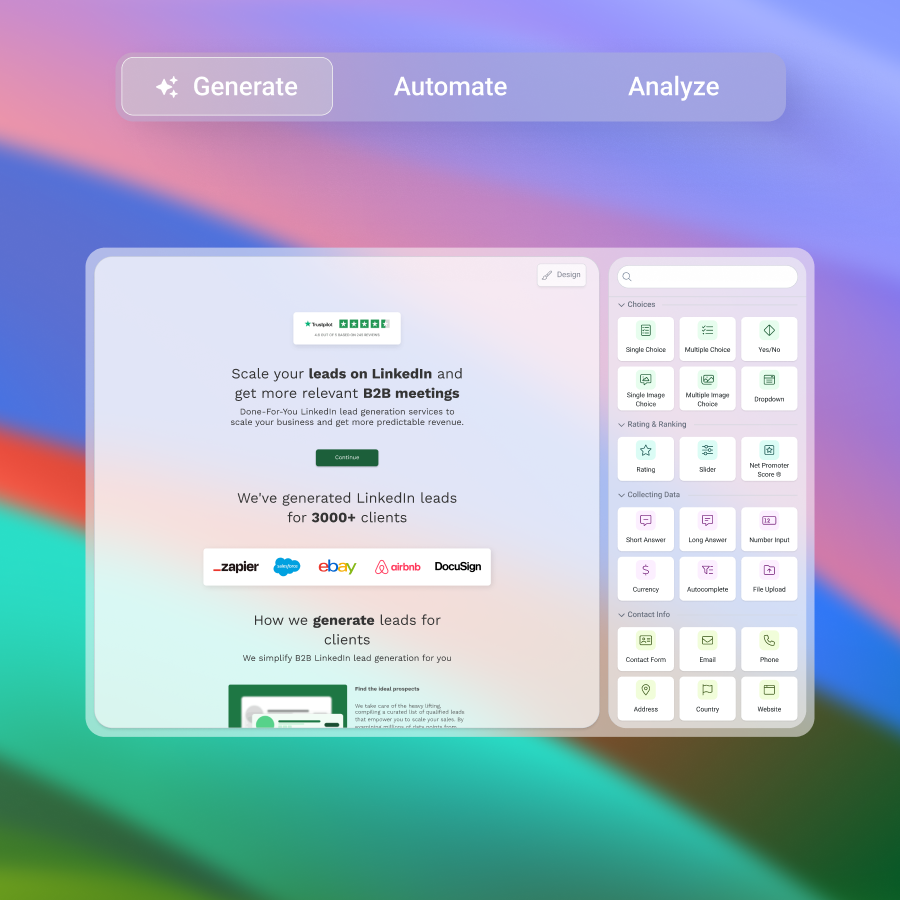
01 Generate & Fine-Tune
Generate branded landing pages from a prompt with the AI landing page builder. Fine-tune conversationally with the AI Agent or with the drag-and-drop editor, then publish as a standalone page on your custom domain, or embed on any website. SSL included.
-

02 Automate Emails
Trigger personalized email sequences from any landing page submission. Use AI to draft email copy and sequences fast, then customize delays, branching, and conditions in the visual workflow builder.
-

03 Analyze & Optimize
Track landing page and email performance in the built-in dashboards. AI Insights surface what's working and where visitors drop off. Run A/B tests on headlines, copy, and designs to keep improving.
Native Integrations
Connect & send landing page data to your favorite apps


SOC 2® Type 2 audited and GDPR-compliant by design


What is a landing page?
A landing page is a standalone web page built specifically for marketing campaigns with one main goal: turning visitors into leads or customers. Regular pages on your site handle many tasks. Landing pages are built around a single desired action, like making a purchase, starting a free trial, downloading a resource, or filling out a form.
Most visitors reach landing pages from targeted sources such as email campaigns, Google Ads, Facebook ads, or social posts. The page is the bridge between your marketing message and the conversion event, so it becomes one of the most important parts of your entire strategy.
You will hear landing pages called different names, depending on the goal:
Lead capture pages, when the focus is collecting contact details
Squeeze pages, when the aim is collecting email addresses
Destination pages, when the page is the final step in a journey
Click through landing pages, when the page sends visitors to another page in the funnel
The core purpose of a landing page
Landing pages are data-driven conversion tools that lean on psychology. They remove distractions, lower friction, and deliver exactly what visitors expect based on how they found you. That focus is a big reason landing pages typically reach average conversion rates of about 9.7%, which is much higher than general website pages.
The main purpose of any landing page is to match visitor intent with your business goal. If someone clicks a Google Ads campaign that promotes a "free marketing audit", they expect a page that gives them that exact offer, not a general homepage with lots of links and topics. That match between traffic source and page content is fundamental for effective campaigns.
The most effective businesses build separate landing pages for each major marketing campaign and keep their homepage for general brand discovery and navigation. This setup lets them tune each page for a single purpose and significantly improve conversion rates across all traffic sources.
What is an AI landing page generator?
An AI landing page generator is a tool that builds a complete landing page from a written prompt. Instead of choosing a template, dragging elements onto a canvas, and writing every section by hand, you describe the campaign in plain language: who the page is for, what offer you are promoting, what action you want visitors to take. The AI then produces the structure, copy, design, embedded form, and outcome page in seconds.
The output is meant to be a starting point, not a final product. Some AI landing page generators, such as involve.me, include a follow-up editing layer, either a conversational AI Agent or a traditional drag-and-drop builder, so the page can be refined section by section before it goes live.
Capabilities vary widely between tools. Basic AI landing page generators output a static one-page result with placeholder copy and stock images. More advanced AI landing page generators build multi-step landing page funnels with branching logic, scoring rules, embedded quizzes or calculators, and personalized outcome pages tailored to each visitor's answers.
The pages that come out of an AI landing page generator are usually mobile-responsive by default and can be published as a standalone page on a custom domain, embedded on an existing website, or triggered as a pop-up.
How does an AI landing page builder work?
AI landing page builders sit on top of large language models that have been trained on landing page copy, design patterns, and conversion principles. Most use a similar three-step pattern.
Step 1: Prompt and brand input
You describe the campaign in a prompt. The clearer the prompt, the better the result. A strong prompt names the audience, the offer, the goal, the qualification logic (what makes a visitor qualified or unqualified), and the next step (calendar booking, payment, ebook download).
Some AI landing page builders also accept a website URL or brand input. The builder then pulls colors, fonts, and logos from the existing site, so the generated landing page lands on-brand instead of with stock styling.
Step 2: Generation
The AI generates the full landing page in seconds: hero headline, supporting copy, embedded form or quiz, scoring rules if the campaign needs qualification, outcome page, and CTA. Advanced AI landing page builders structure the output as a multi-step funnel by default if the prompt mentions qualification, scoring, or routing.
Step 3: Refine and publish
The generated page is fully editable. Refinements come in two flavors: conversational ("Make the hero shorter, change the CTA to 'Get my free quote', add a testimonial below the form") or direct ("drag this element, edit this copy, change this color"). Once the page looks right, publish it to a custom domain with SSL, embed it on an existing website, or trigger it as a pop-up.
The best AI landing page builders connect the published page directly to an email automation workflow and a CRM, so every submission becomes a contact record and triggers a personalized email sequence based on the visitor's answers, score, and outcome.
AI landing page generator vs. traditional landing page builder
The difference is speed at the front and depth at the back.
A traditional landing page builder starts from a template or a blank canvas. You drag elements, write copy, set the form fields, configure the routing logic, and design the outcome page yourself. The process takes hours for a single-step page, days for a multi-step funnel. The upside is total control over every detail.
An AI landing page generator starts from a prompt. The AI produces the structure, copy, design, embedded form, and outcome page in seconds. You then refine the result. The process takes minutes, not hours. The upside is speed plus a quality floor: even a first draft is usable, which matters for businesses that need to launch many campaigns quickly.
Most modern landing page tools offer both routes inside the same builder. You start with AI generation, then move into manual editing for the parts that need polish. The hybrid pattern is how the fastest marketing teams launch high-volume campaigns without sacrificing the bespoke feel of hand-built pages.
The capability gap is widest at the back of the page. A basic AI landing page generator outputs a static one-page result. A full landing page builder with AI generation produces a multi-step funnel with logic jumps, conditional fields, real-time lead scoring, OTP verification on email and SMS, embedded payments, outcome pages that render personalized charts, gauges, and graphs based on each visitor's answers, and a built-in email automation workflow that branches on answers, scores, opens, and clicks. The deeper the capability stack, the closer the AI landing page generator gets to replacing a multi-tool marketing stack.
What is the difference between a landing page and a homepage?
The key difference between landing pages and homepages is their purpose and design approach. Your homepage is like the front entrance to your business, welcoming all kinds of visitors and offering many paths to explore your site. In contrast, landing pages behave more like specialized reception desks that handle certain types of visitors with specific messaging and clear next steps.
Homepages usually include full navigation menus, footer links, sidebar widgets, and multiple calls to action that can pull visitors in several directions. They are built to support different visitor goals, such as learning your company history, reading blog posts, checking prices, or finding customer support. This flexibility often reduces the focus on conversions.
Landing pages remove these extra choices by hiding navigation menus and limiting options to one main call to action. Studies show that landing pages, on average, convert about 23% better than sending traffic to homepages. This increase comes from avoiding what psychologists call "choice paralysis", when too many options keep people from making any decision.
What are the essential elements of high-converting landing pages?
Top-performing landing pages tend to share similar traits that psychology and testing show to be effective. These pieces work together to create an experience that feels clear and natural for visitors, no matter where they came from or what device they use.
Compelling headlines that capture attention
Your headline is the first element visitors see and often determines whether they stay on your page or bounce within seconds. Strong headlines share the main benefit or offer in about 5 to 9 words, so the value is obvious as soon as someone lands on the page.
A clear headline should connect directly to the ad, email, or link that brought visitors there. This message match helps people feel sure they reached the right place. If your Google Ads campaign promises "Get 50% Off Premium Website Templates", the landing page headline should repeat this offer, instead of using a generic line like "Welcome to Our Store".
Strong headline examples include benefit-focused statements like "Double Your Email List in 30 Days", "Get Instant Access to Professional Templates", or "Schedule Your Free Marketing Audit Today". These headlines immediately communicate what visitors will receive and create urgency or desire to learn more.
Clear and persuasive call-to-action buttons
Your call to action (CTA) button is the most critical item on the page, because it is where conversions actually happen. The design, placement, and copy of your CTA can make the difference between a successful campaign and wasted advertising spend.
CTA text should be action-oriented and specific about what happens next, instead of generic phrases like "Submit" or "Click Here".
For most landing pages, follow a single CTA rule: focus visitors on one main action and avoid several competing choices. On longer pages, you can repeat the same CTA in several places, for example, after sections that list benefits or answer objections.
Trust signals and social proof
Building credibility quickly is essential since many landing page visitors are encountering your business for the first time. Trust signals and social proof elements help overcome skepticism and encourage visitors to take action by demonstrating that others have successfully used your products or services.
Trust-building elements include:
Customer testimonials
Security badges and certifications
Client logos from recognizable companies
Media mentions or "As seen on" badges
User review ratings and scores
Case study summaries with specific results
Professional associations and accreditations
Contact information and business address
Social proof is most effective when it matches your audience. B2B landing pages should emphasize testimonials from business clients and industry certifications, while B2C pages might lean more on customer reviews and guarantee badges.
Optimized forms and data collection
Form optimization directly impacts your lead generation success, as even small improvements can significantly boost conversion rates. The key principle is collecting only essential information needed for your follow-up process while minimizing friction for users.
Research consistently shows that reducing form fields from four to three can improve conversions by up to 50%. Limit initial data collection to what you absolutely need. You can collect more details later through progressive profiling and follow-up.
Mobile form optimization is crucial since over 50% of traffic typically comes from mobile devices. Ensure form fields are large enough for easy typing, use appropriate input types (email keyboards for email fields), and minimize the number of required fields for mobile users.
What are the main types of landing pages?
Different marketing goals call for different landing page styles. Knowing the main landing page types and where they fit helps you choose the right approach for each campaign and tune your pages for stronger results.
Lead generation landing pages
Lead generation landing pages focus on exchanging valuable content or offers for contact information, making them essential tools for building your email list and qualifying potential customers. These lead gen landing pages typically offer free resources like ebooks, webinars, consultations, or exclusive content in return for basic contact details.
A strong lead generation landing page keeps friction low while making the offer feel clearly valuable. Visitors must feel the benefit is worth sharing their information, so your copy needs to explain that benefit in simple, specific terms. High-performing offers often include industry reports, how-to guides, free tools, or exclusive discounts.
Since the form is the main conversion point on these pages, form optimization is especially important. Test different lengths, which fields are required, and where the form sits on the page, so you collect what your sales team needs while keeping completion rates high.
Click-through landing pages
Click-through landing pages act as a middle step between your first marketing message and a more complex conversion, such as a checkout or long signup flow. They warm up visitors by offering more information and building interest before asking for a purchase or detailed registration.
Unlike lead gen pages that collect details immediately, click-through pages focus on explaining and persuading first, then sending visitors to another page where they actually convert. This structure works well for higher-priced products or services that need more consideration.
E-commerce brands use click-through landing pages to highlight special product benefits, show customer reviews, and address objections before sending visitors to the product page or checkout. This extra step often increases conversions by bringing more committed visitors into the purchase process.
SaaS companies often send traffic to click-through landing pages before a trial signup. These pages share feature summaries, customer stories, and pricing details, then direct visitors to the registration form. This helps qualify leads and can reduce trial abandonment.
Event registration and webinar pages
Event registration landing pages require specific elements that address the unique nature of time-sensitive, scheduled offerings. These pages must communicate event value while creating urgency around limited availability or early registration benefits.
You create urgency in an honest way by highlighting true limits, such as a set number of seats, early bird pricing, or exclusive access. Statements like "Only 50 Seats Remaining" or "Early Bird Pricing Ends Friday" can encourage fast action, as long as they reflect real constraints.
Integrations can improve the experience for event landing pages. Connect your registration form with calendar apps so attendees can save the event automatically. Set up confirmation emails with all details, plus reminders in the days or hours before the event.
Strong webinar landing pages often include speaker photos and short bios to build trust, especially for professional audiences. They also explain specific outcomes, such as "Learn the 5-step process to double your conversion rates", instead of using vague promises.
What are the landing page best practices for design and UX?
Good landing page design balances visual appeal with conversion goals. It uses layout, spacing, and color to highlight key elements. The best designs cut distractions but still look professional and trustworthy.
Mobile-first design principles
Mobile traffic now often makes up more than 60% of visits in many markets, so mobile optimization is essential. A mobile-first mindset means you design for phones and tablets first and then make sure things still look good on desktop.
Responsive design needs to do more than shrink content to fit smaller screens. Mobile users scan content quickly and want your main message and CTA right away. Your mobile layout should place the headline, main benefit, and CTA near the top of the screen.
Take the following points into consideration:
Thumb-friendly design means buttons must be large enough and spaced well.
Single-column layouts usually work best on mobile landing pages.
Forms on mobile need special care, since typing on a phone is harder, so use mobile-friendly input fields.
Page speed is even more important on mobile, where connections can be weaker.
Page loading speed and technical optimization
Page loading speed has a direct impact on conversions. Studies show that about 40% of people leave pages that take more than 3 seconds to load, and even a 1-second delay can lower conversions by up to 7%. That makes speed a core part of landing page optimization.
Core Web Vitals are Google's measures for user experience, covering load speed, interactivity, and how stable content looks as it loads. These metrics affect both user satisfaction and search rankings, so they matter for paid and organic traffic.
Technical optimization checklist:
Compress and optimize all images
Minimize CSS and JavaScript files
Use a reliable CDN for faster content delivery
Implement browser caching for repeat visitors
Choose fast, reliable hosting for your landing pages
Test loading speeds on various devices and connections
How to measure landing page success?
Good landing page analytics go beyond counting conversions. They help you see how people behave on the page, whether traffic is qualified, and how each campaign performs. This level of insight lets you optimize in a structured and repeatable way.
Conversion rate optimization metrics
Conversion rate is the main measure of landing page performance. You calculate it by dividing the number of conversions by the number of visitors, then multiplying by 100. Benchmarks vary, but many solid campaigns convert in the 2 to 5% range, and standout pages can reach 10% or higher.
Cost per acquisition (CPA) tells you how much you pay for each conversion. You get it by dividing your total ad spend by the number of conversions. This metric helps you judge if a campaign is profitable and compare landing pages and traffic sources.
Return on ad spend (ROAS) gives a wider view of profitability. It compares the revenue generated to your ad costs. A ROAS of 3:1 means you bring in 3 dollars for every dollar spent, though target numbers differ by business type.
Other useful metrics include:
Bounce rate, the percentage of people who leave without taking action
Time on page, how long visitors stay and interact
Scroll depth, how far down the page visitors go
Form abandonment rate, the percentage who start but do not finish forms
Performance by traffic source, conversions broken down by channel
A/B testing strategy and implementation
Structured A/B testing helps you steadily improve your landing page results by comparing two versions and keeping changes that increase conversions. The best testing plans focus on elements likely to have the biggest impact and follow basic rules for reliable data.
You should start testing elements that affect decisions the most. Begin with headlines, CTA buttons, and form design before moving on to smaller tweaks like minor color changes or font choices. This focus gives you more value from each test.
Your test should run long enough to reach statistical significance and account for weekly patterns. Running tests for full weeks helps even out weekday and weekend differences in behavior.
The landing page playbook

What is a landing page
Learn what a landing page is, how it differs from a homepage, and the elements that boost conversions, plus how to build one fast with involve.me templates.
Learn more
The anatomy of a landing page
Learn the anatomy of high-converting landing pages and how to assemble each section. Master landing page layout, best practices, and optimization tips to increase conversions
Learn more
Landing page optimization
Learn how to optimize your landing pages for higher conversions with our expert guide. Discover best practices, tools, and how involve.me can help you build smarter, high-performing pages.
Learn more
11 landing page best practices
Discover the proven best practices to design high-converting landing pages, plus how to build, test, and optimize every page with involve.me’s AI-powered builder.
Learn more
Events landing page optimization
Learn how to design and optimize an event landing page that drives RSVPs, registrations, and ticket sales. Explore best practices and mistakes to avoid.
Learn moreFAQs
-
involve.me's AI Landing Page Generator builds branded landing pages and multi-step landing page funnels in seconds. Describe your campaign in a prompt and the AI Agent generates the page: copy, design, embedded form, quiz, or calculator elements, and outcome pages. Optionally paste your website URL to pull your branding (colors, fonts, logo) for an on-brand result. Built for high-ticket service businesses, expert-led businesses, and high-consideration product brands that need to capture, qualify, and follow up with high-value leads. Refine any part of the page conversationally with the AI Agent or with the drag-and-drop landing page builder.
-
No, the AI landing page builder is fully no-code. Describe your campaign in a prompt and the AI Agent generates the landing page in seconds. Optionally paste your website URL to pull your branding (colors, fonts, logo). Once generated, refine any part of the page conversationally with the AI Agent or with the drag-and-drop editor, then publish to a custom domain with SSL included, embed on any website, or trigger as a pop-up.
-
Yes. The AI generates a fully branded foundation, then the AI Agent and drag-and-drop editor let you customize copy, design, layout, and the embedded interactive elements: quizzes, calculators, surveys, and forms. Add answer piping, logic jumps, conditional logic, lead scoring, and Personalized AI Text so every visitor sees a unique outcome based on their answers. Connect the landing page to a built-in email automation workflow that sends personalized email sequences based on each lead's answers, score, opens, and clicks.
-
Yes. All landing pages are mobile-first and responsive. The layout adjusts across every screen size, so you can reach high-value leads on any device.
-
Yes. Common use cases include lead magnets, webinar registrations, product launches, discovery call bookings, job applications, and product finder pages. Built for high-ticket service businesses (financial advisors, insurance brokers, real estate, mortgage, solar, med spas, education providers), expert-led businesses (coaches, consultants, advisors, course creators), and high-consideration product brands (skincare, wellness, furniture, mattresses, B2B software, custom products). Describe the goal of your campaign in the prompt and the AI Agent tailors the landing page to fit.
-
The AI Agent processes your prompt and generates a branded landing page within seconds. Once generated, customize and publish at your convenience. You can have a conversion-focused landing page connected to a personalized email sequence ready to share in minutes.
-
We offer flexible plans to accommodate different needs. Depending on your plan, you can create a set number of live landing pages. Check "live funnels" on our pricing page for more information.
-
Yes. involve.me has 55+ native integrations covering the major CRMs, email service providers, and productivity tools, including HubSpot, Salesforce, ActiveCampaign, Brevo, Mailchimp, Klaviyo, Pipedrive, and Google Sheets. Check the integrations page for the full list. If your tool is not there, Zapier and webhooks connect to anything else. Every lead arrives in your stack with their answers, score, and segment already attached.
-
involve.me includes a built-in analytics dashboard that tracks visits, completion rates, drop-offs, and time-to-complete step by step. Dig into individual responses, build contact profiles, and segment leads by answer or score. AI Insights summarizes performance, surfaces what is working, flags where visitors drop off, and recommends what to improve, so you spend less time sifting through data.
-
Yes, we offer a built-in A/B test feature. You can create multiple variations of your landing page to test different versions of your landing pages. This allows you to identify which design or content performs best with your audience. You can monitor each version’s performance and optimize your landing pages for better results.
-
involve.me is SOC 2 Type II audited and GDPR-compliant. All data is encrypted in transit and at rest. We never share or sell your data (or your visitors' data) to third parties. OTP verification on email and SMS blocks junk submissions before they enter any workflow. Enterprise plans add SSO/SAML2 and configurable data retention per landing page.
-
Yes! involve.me allows you to publish your landing page on your own custom domain. You can also embed your landing page as a full page on an existing website, in just a few clicks.
-
Beyond AI generation, involve.me has:
- AI Agent. Builds and edits complete funnels through chat: flow structure, routing logic, copy, design, scoring rules, formulas, and full page layouts.
- Personalized AI Text. Writes unique outcome copy for every respondent based on their answers.
- AI Bulk Question Generation. Drafts lists of relevant questions for any form, quiz, or survey topic.
- AI Email Copy. Drafts entire email sequences and individual emails inside the workflow builder.
- AI Insights. Analyzes form submissions and generates downloadable reports with key findings, drop-off points, and recommendations.
- AI Formula Generation. Translates natural-language descriptions into working calculator and scoring formulas.
-
involve.me takes over the follow-up automatically. Every submission creates a contact record in our built-in CRM, with mapped properties, answers, scores, and segments attached, then feeds into the visual workflow builder.
From there, set up personalized email sequences that branch on answers, scores, outcomes, opens, and clicks. A lead who scored high gets a different sequence than one who scored low. A lead who clicked the booking link gets a different sequence than one who did not. Payment events trigger their own flows. AI drafts the email copy fast.
You can also push leads into your existing stack via 55+ native integrations, Zapier, Make, or webhooks. View, filter, tag, segment, and export every contact directly inside involve.me, and edit the workflows any time.
-
With involve.me, you don’t need a website to create a landing page. Simply use our landing page builder to build your page and host it instantly on our servers. There is no separate domain or site required, unless you want to use your own.