

A well-designed customer engagement model is no longer optional. It is a strategic framework that defines how your business builds meaningful relationships across the entire customer journey, from first interaction to repeat purchases and long-term loyalty.
Companies that implement the right customer engagement model do more than communicate with customers. They create structured, measurable systems that enhance customer interactions, strengthen customer relationships, and drive sustainable business growth.
According to Gallup, fully engaged customers represent a 23% premium in terms of share of wallet, profitability, revenue, and relationship growth compared to average customers. That statistic alone shows why customer engagement models matter.
This article explores what a customer engagement model is, and how businesses can design the right customer engagement model to improve customer satisfaction, strengthen customer relationships, and increase customer lifetime value.
What Is a Customer Engagement Model?
A customer engagement model is a structured approach that defines how a business interacts with its target audience across the customer lifecycle. It aligns engagement strategies with business objectives, ensuring that every customer interaction supports measurable outcomes such as higher customer lifetime value, improved customer satisfaction, and stronger retention.
Unlike random engagement efforts, an effective engagement model integrates a clear customer engagement strategy, defined customer engagement goals, alignment with the entire customer journey, measurable engagement metrics, and a deep understanding of customer needs and customer behavior.
The goal is to enhance customer engagement consistently rather than relying on isolated campaigns.
Businesses that apply a successful customer engagement model see measurable improvements in customer satisfaction scores, loyalty, and revenue performance.
Research from Harvard Business Review shows that increasing customer retention rates by just 5% can increase profits by 25% to 95%.
Meanwhile, Bain & Company reports that loyal customers are significantly more likely to make repeat purchases and become brand advocates.
Customer engagement directly impacts customer lifetime value, customer loyalty, client satisfaction, repeat business, net promoter score (NPS), and overall business growth. When customers experience positive experiences throughout the entire customer journey, they are more likely to become loyal customers who generate long-term value.
Core Elements of a Successful Customer Engagement Model
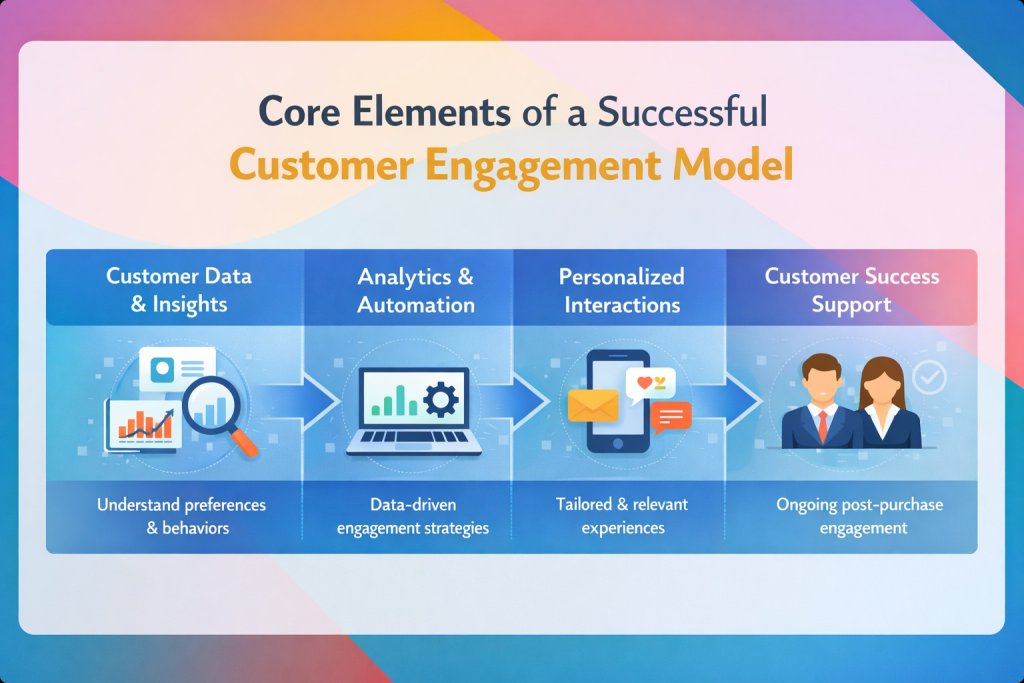
1. Deep Understanding of Customer Data, Preferences, and Behavior
An effective customer engagement strategy begins with a deep understanding of customer data, customer preferences, and customer behavior. Without clear insights, engagement efforts become reactive rather than strategic. Businesses need visibility into how customers move through the entire customer journey, what influences their decisions, where friction occurs, and what drives repeat purchases.
By analyzing behavioral patterns, purchase history, support interactions, and engagement signals, companies can build a structured customer engagement process rather than relying on assumptions. This deep understanding allows businesses to align engagement strategies with real customer needs and long-term business objectives, ensuring every interaction contributes to stronger customer relationships and higher customer lifetime value.
2. Data-Driven Decisions Through Analytics and Automation
A successful customer engagement model depends on measurable insights. Companies that leverage analytics tools and automation tools gain a clearer view of engagement metrics such as retention rates, customer lifetime value, customer satisfaction scores, and net promoter score (NPS).
Tracking these engagement metrics ensures that engagement efforts are tied to performance outcomes rather than surface-level activity. For example, analyzing changes in NPS can reveal whether customer experience improvements are translating into stronger loyalty. Monitoring retention and lifetime revenue per customer helps businesses evaluate whether their engagement strategies are producing sustainable growth.
According to Salesforce, 73% of customers expect companies to understand their unique needs and expectations.
This statistic reinforces the importance of using data intelligently. Delivering personalized interactions is no longer optional; it is expected. Businesses that fail to use customer data effectively risk falling behind competitors who adopt a more structured engagement model.
3. Personalized Interactions Across Every Touchpoint
A strong engagement model delivers personalized interactions at every touchpoint throughout the customer lifecycle. This includes relevant content aligned with specific pain points, targeted marketing campaigns tailored to customer preferences, and proactive communication that enhances customer interactions.
Personalization goes beyond adding a name to an email. It means understanding where the customer is in the journey, what product or service challenges they are facing, and what information they need next. When companies consistently provide relevant content and positive experiences, they enhance customer satisfaction and create meaningful interactions that strengthen long-term relationships.
This level of personalization contributes directly to higher customer satisfaction, improved loyalty, and increased repeat business. Over time, satisfied customers become loyal customers and even brand advocates who promote your product or service organically.
Pro Tip: You can also create online quizzes using AI quiz generator within seconds.
4. Strong Customer Success and Post-Purchase Engagement
Customer engagement does not stop at acquisition. In fact, some of the most important engagement happens after the sale. A successful customer engagement model clearly defines how customer success teams support ongoing relationships.
This may involve assigning a dedicated customer success manager or dedicated account managers to high value clients. These professionals ensure that customers continue to see measurable value from the product or service, helping to maintain meaningful relationships and prevent churn.
Effective customer success engagement includes proactive check-ins, performance reviews, onboarding support, and guidance that aligns with customer needs. This approach not only enhances customer satisfaction but also strengthens customer loyalty and increases customer lifetime value.
When businesses maintain engagement beyond the initial purchase, they create stronger customer relationships that lead to repeat purchases and sustainable business growth. Engaged customers tend to stay longer, spend more, and recommend the brand to others.
Types of Customer Engagement Models
There are various customer engagement models that businesses can apply depending on their product or service complexity, customer lifetime value, and overall business objectives. Below are the most common models.
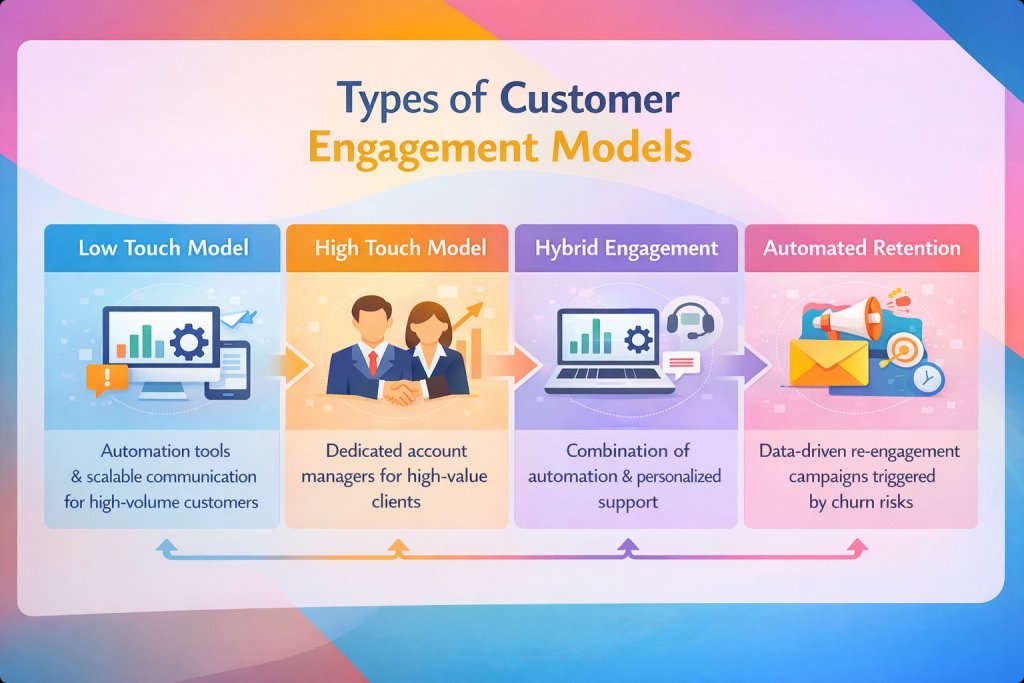
Low Touch Engagement Model
A low touch engagement model relies heavily on automation tools, scalable communication systems, and self-service resources. It is ideal for businesses managing a high volume of customers with relatively lower individual contract values.
In this model, engagement is driven through automated onboarding emails, in-app tutorials, help centers, knowledge bases, webinars, and targeted marketing campaigns. Analytics tools track engagement metrics such as feature usage, login frequency, customer satisfaction scores, and retention trends.
For example, a SaaS company offering project management software for small businesses may use a low touch engagement model. After sign-up, customers receive automated onboarding sequences, guided product tours, and educational email workflows. If a user’s activity drops, the system automatically triggers a re-engagement email with relevant content. There is minimal human involvement unless a support ticket is raised.
This model enhances customer engagement efficiently while keeping operational costs scalable.
High Touch Engagement Model
A high touch engagement model focuses on personalized, relationship-driven engagement. It is typically used for high value accounts where customer lifetime value is substantial and the product or service is complex.
In this approach, businesses assign dedicated account managers or a dedicated customer success manager to ensure meaningful interactions. Engagement includes quarterly business reviews, strategy calls, tailored reporting, and proactive optimization support. The focus is on strengthening customer relationships and delivering consistent value.
For example, an enterprise cybersecurity provider serving multinational corporations would use a high touch engagement model. Each client is assigned a dedicated account manager who conducts regular check-ins, shares threat intelligence updates, provides customized security assessments, and aligns service delivery with the client’s business objectives.
This model enhances customer satisfaction and strengthens long-term relationships by delivering personalized interactions at every stage.
Hybrid Engagement Model
A hybrid engagement model combines automation tools with personalized customer success support. It balances scalability and personalization, making it highly effective for growing SaaS and B2B companies.
Automation handles onboarding flows, educational content, product updates, and engagement tracking. Customer success teams step in strategically for high-impact accounts or at critical points in the customer journey, such as renewal discussions or upsell opportunities.
For example, a marketing automation platform serving mid-sized businesses may use automation for onboarding and monthly performance reports. However, once a client reaches a certain subscription tier or usage level, a customer success manager is assigned to provide tailored optimization recommendations and campaign strategy guidance.
This strategic framework improves customer engagement across the entire customer lifecycle while preserving operational efficiency.
Automated Retention Model
An automated retention model focuses specifically on identifying churn risks and triggering proactive re-engagement strategies. It relies on customer data, behavioral analytics, and engagement metrics such as net promoter score (NPS) and product usage trends.
When engagement drops or satisfaction scores decline, automation tools trigger targeted interventions such as educational emails, loyalty incentives, feature tutorials, or account health alerts.
For example, a subscription-based analytics platform monitors user activity. If a client’s usage declines by 40% over a 30-day period, the system automatically sends personalized insights about unused features and invites the client to a training webinar. If inactivity continues, the account is flagged for outreach from a customer success manager.
This model enhances customer engagement proactively and protects customer lifetime value by reducing churn before it happens.
Choosing the Right Customer Engagement Model
Selecting the right customer engagement model depends on your product complexity, customer lifetime value, and overall business objectives. Companies serving enterprise clients may lean toward high touch engagement, while product-led growth businesses often start with a low touch model and evolve into hybrid engagement.
Research from McKinsey & Company shows that companies that excel at personalization can generate 5–15% revenue growth and improve marketing ROI by 10–30%. This reinforces that personalization within any engagement model drives measurable results.
Engaged customers tend to purchase more frequently, stay longer, and become brand advocates. Higher customer satisfaction correlates directly with stronger loyalty programs, repeat business, and long-term value creation. When businesses enhance customer interactions consistently across the entire customer journey, they build stronger customer relationships and create a successful customer engagement model that supports sustainable business growth.
How involve.me Helps You Apply a Customer Engagement Model in Your Business
Applying a structured customer engagement model requires more than strategy documents. It requires the right tools.
involve.me, the AI quiz funnel builder with a built-in CRM and email automation, lets businesses operationalize their customer engagement framework: build interactive funnels that capture data, then trigger personalized, multi-step email sequences that guide each contact through the journey.
With involve.me, companies can build interactive funnels that enhance customer engagement, collect actionable customer data, deliver personalized interactions at scale, improve customer satisfaction with relevant content, support targeted marketing campaigns, strengthen customer relationships through automated and hybrid engagement flows, and increase customer lifetime value through data-driven engagement strategies.
Instead of relying on static pages and generic communication, involve.me allows businesses to design meaningful interactions that drive deeper engagement and measurable results.
If your goal is to implement the right customer engagement model and produce satisfied customers who become loyal brand advocates, involve.me provides the infrastructure to make it happen.
Start building smarter engagement funnels with involve.me, the AI quiz funnel builder with a built-in CRM and email automation.
Create Your Own Customer Engagement Tools
Get Started with 300+ Templates

Brand Knowledge Quiz for CPG and DTC Template

What's your skin type? Template

Big Five Personality Test Template

Personality Quiz for Online Magazines and News Websites Template

Financial Literacy Knowledge Quiz Template