

B2B customer engagement is no longer just about staying in touch. It’s about creating meaningful interactions across the entire buyer’s journey, delivering consistent value, and building long term customer relationships that increase customer lifetime value and fuel sustainable business growth.
Today, companies must effectively engage both new customers and existing customers across multiple channels and multiple touchpoints, while adapting to evolving customer expectations.
According to Gallup, fully engaged customers represent a 23% premium in share of wallet, profitability, revenue, and relationship growth compared to average customers. Meanwhile, research from Forrester shows that customer-obsessed companies grow revenue 2.5x faster than those that are not.
The message is clear: engagement is revenue.
What Is B2B Customer Engagement?
If we talk about customer engagement, it refers to how customers interact with your brand across the entire sales funnel, including marketing campaigns, virtual events, interactive experiences, support conversations, and post-purchase interactions. It reflects the quality and depth of the relationship between a company and its audience at every stage of the buyer’s journey.
For a B2B customer, engagement is significantly more complex than in B2C environments. It typically involves multiple stakeholders, often including C-suite executives, and requires navigating a longer and more structured sales process. Deal sizes are larger, particularly when targeting high value accounts, and the relationship does not end at conversion. Instead, it continues through ongoing collaboration between sales teams, account managers, and customer success professionals who work together to nurture long term relationships.
Strong customer engagement efforts go beyond surface-level communication. They require a deep understanding of customer behavior, a clear focus on solving specific pain points, and the ability to deliver personalized experiences that resonate with decision-makers. Trust must be built through transparent business practices, and businesses must consistently provide ongoing value well beyond the initial acquisition phase. In B2B, engagement is not a single interaction, it is a sustained strategy designed to strengthen customer relationships over time.
Why B2B Customer Engagement Matters for Business Goals
Effective engagement has a direct and measurable impact on core business goals. It influences customer acquisition by helping brands connect with the right target audience, improves customer retention by strengthening satisfaction and loyalty, and increases both customer loyalty and brand loyalty through consistent, meaningful interactions. Ultimately, it drives higher customer lifetime value, which is one of the most important indicators of sustainable growth.
Research supports this connection. According to Harvard Business Review, increasing customer retention rates by just 5% can increase profits by 25% to 95%. Similarly, Bain & Company reports that loyal customers are more likely to generate positive word-of-mouth and purchase additional products, reinforcing long term revenue potential. Furthermore, McKinsey & Company found that companies implementing personalization at scale can increase revenues by 5–15% and improve marketing ROI by 10–30%.
The conclusion is clear: deeper engagement is not just a marketing objective. It is a strategic driver of measurable financial performance, stronger customer satisfaction, and long term business growth.
Key Components of an Effective B2B Customer Engagement Strategy
A strong customer engagement strategy aligns with your broader marketing strategy and business goals.
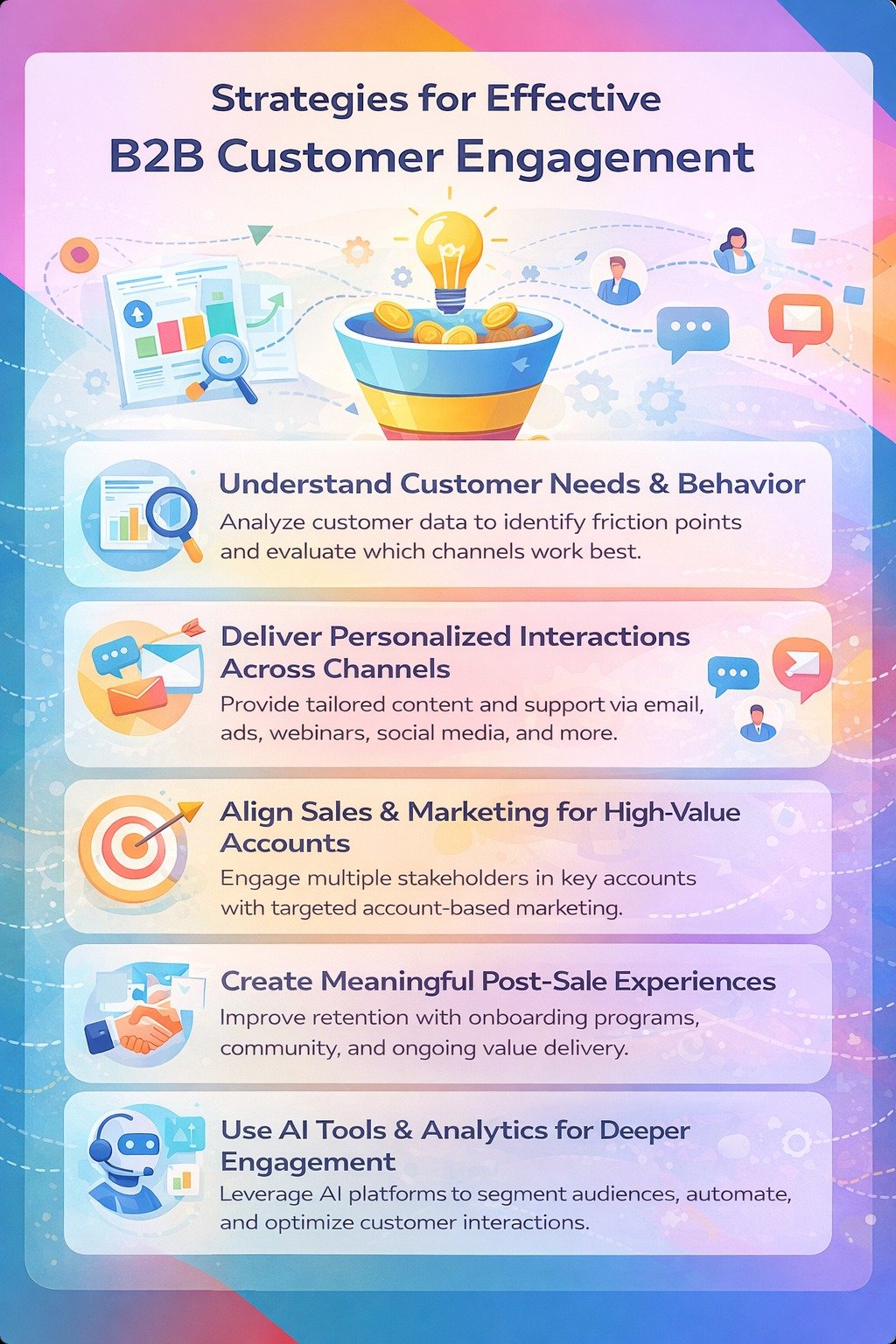
1. Understand Customer Needs and Behavior
An effective customer engagement strategy begins with a deep understanding of customer needs and customer behavior. Businesses should leverage customer data, insights from analytics platforms, and valuable insights gathered from support interactions to understand how customers interact with their brand. This includes identifying what content or offers generate the most interaction, where friction occurs within the sales funnel, which engagement channels deliver the strongest results, and how different segments within the target audience evaluate solutions.
By consistently tracking key metrics such as engagement rate, retention rate, and customer lifetime value, companies ensure their engagement efforts remain data-driven and aligned with measurable business goals rather than assumptions.
2. Deliver Personalized Interactions Across Multiple Channels
Modern B2B buyers expect personalized interactions across multiple channels and multiple touchpoints. These may include email campaigns, paid advertising, third party sites, webinars and virtual events, user groups, and social media or industry communities. Buyers no longer engage in a single place; they move fluidly across platforms during the buyer’s journey.
According to Salesforce, 73% of customers expect companies to understand their unique needs and expectations. Meeting these expectations requires delivering personalized support, sharing relevant content aligned with specific pain points, and crafting industry-relevant messaging that reflects current industry trends. When businesses tailor communication effectively, they create meaningful customer experiences that drive deeper engagement and long term customer relationships.
3. Align Sales and Marketing for High-Value Accounts
To effectively engage high value accounts, alignment between marketing and sales teams is essential. Through account based marketing, organizations can focus on strategically important accounts and engage multiple stakeholders, including decision-makers and C-suite executives, throughout the sales process.
This coordinated approach improves the overall quality of high quality leads, increases efficiency within the sales funnel, strengthens collaboration between teams, and drives higher conversion rates from lead to opportunity. Instead of generating surface-level interest, targeted engagement ensures companies are consistently generating high quality leads that are more likely to convert into long term relationships.
4. Create Meaningful Customer Experiences Post-Sale
B2B customer engagement does not end once a contract is signed. Strong post sale engagement plays a critical role in improving customer retention, customer satisfaction, and brand loyalty. Effective strategies may include structured onboarding programs, educational resources that help customers maximize value, interactive events, community-driven user groups, and proactive outreach from customer success teams.
Organizations that focus on delivering consistent value after acquisition are better positioned to build long term relationships and increase overall customer lifetime value. By maintaining engagement beyond the initial transaction, businesses reinforce trust and strengthen customer relationships over time.
5. Use AI Tools and Analytics for Deeper Engagement
Modern AI tools and advanced analytics platforms allow companies to achieve deeper engagement with greater precision. These technologies enable businesses to segment audiences intelligently, automate re-engagement strategies, deliver personalized experiences at scale, identify drop-offs within the sales funnel, and optimize messaging based on real-time behavioral signals.
According to Gartner, organizations that leverage AI in customer engagement initiatives report significant productivity improvements and improved targeting accuracy. When used strategically, AI enhances both operational efficiency and the overall quality of customer experiences, helping companies effectively engage their audience at every stage of the relationship lifecycle.
Measuring Success: Key Metrics for B2B Engagement
To evaluate solutions and track performance, monitor:
Engagement rate
Conversion rate
Customer retention rate
Customer satisfaction score
Customer lifetime value
Revenue per account
Expansion revenue from existing customers
Tracking these key metrics ensures your engagement efforts are aligned with revenue and long-term business growth.
How involve.me Helps in B2B Customer Engagement
Building meaningful engagement requires interactive, personalized experiences plus consistent follow-up, and this is where involve.me, the AI quiz funnel builder with a built-in CRM and email automation, makes a difference. Use it to build multi-step funnels, capture and qualify leads, and then automatically send the email sequences that keep every account engaged across the buyer's journey.
With involve.me, businesses can:
Build personalized, multi-step funnels to guide the buyer’s journey
Capture and qualify high quality leads automatically
Create calculators, quizzes, and interactive assessments to address specific pain points
Deliver personalized experiences at scale
Collect and analyze customer data for better segmentation
Improve conversion rates across the sales funnel
Support account based marketing strategies
Generate deeper engagement through interactive touchpoints
Track performance using built-in analytics
Instead of static web pages, involve.me enables brands to create meaningful customer experiences that help customers evaluate solutions, interact meaningfully, and move confidently through the buying process.
If your goal is to build strong customer relationships, boost loyalty, and increase customer lifetime value, involve.me provides the tools to make it happen.
Start building high-converting B2B engagement funnels with involve.me, the AI quiz funnel builder with a built-in CRM and email automation.
Create Your Own Customer Engagement Tools
Get Started with 300+ Templates

Child Savings Calculator for Finance Template

Brand Knowledge Quiz for CPG and DTC Template

What's Your Travel Type? Template

Calculate My Credit Score Quiz Template

What Animal Are You? Template

CPM Calculator Template
Boost Own Customer Engagement with involve.me
No coding, no hassle, just better conversions.
References
https://www.gallup.com/workplace/236927/employee-engagement-drives-growth.aspx
https://www.forrester.com/report/the-business-impact-of-customer-obsession/RES176690
https://hbr.org/2014/10/the-value-of-keeping-the-right-customers
https://www.bain.com/insights/the-economics-of-loyalty/
https://www.salesforce.com/resources/research-reports/state-of-the-connected-customer/