

Customer engagement plays a direct role in how customers perceive your business, how long they stay, and how much they spend. In today’s market, customers expect meaningful interactions, fast responses, and personalized experiences across multiple channels.
This article explains customer engagement best practices, why they matter, and how businesses can use customer data, feedback, and communication tools to engage customers more effectively, improve customer retention, and increase customer lifetime value.
Customer Engagement Best Practices
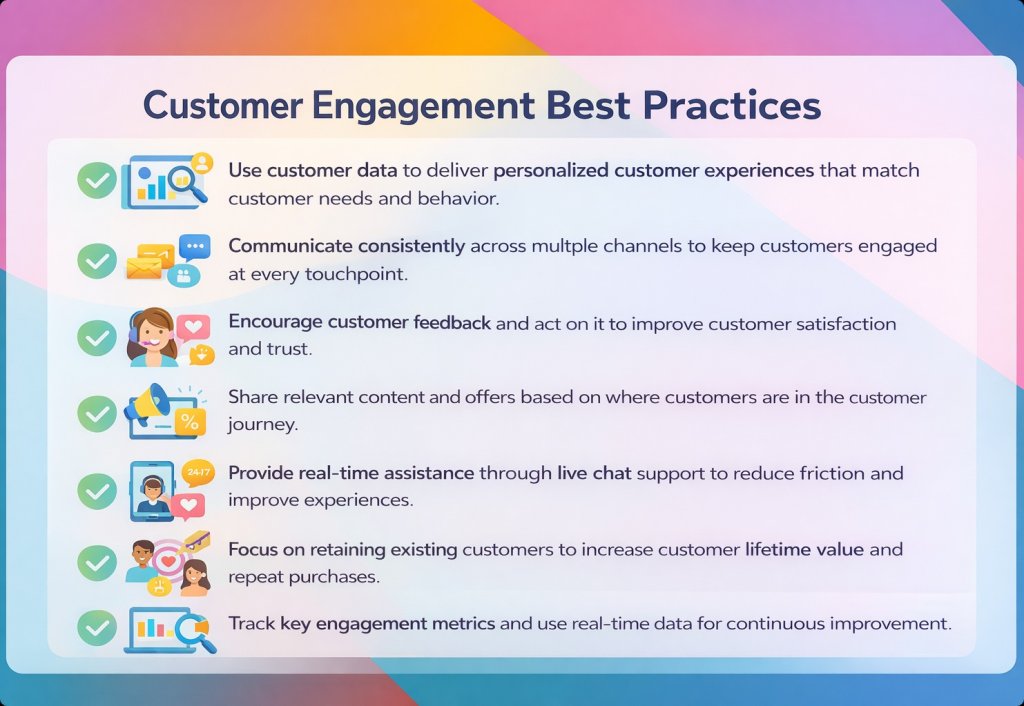
1. Use Customer Data to Create Personalized Customer Experiences
Using customer data is one of the most effective engagement strategies. When businesses understand customer behavior, purchase history, and preferences, they can deliver relevant content and offers that feel personal rather than generic.
Personalized customer experiences help customers feel valued and understood. This can include recommending product offerings based on past purchases, sending relevant follow-up emails, or adjusting messaging based on where a customer is in the customer journey.
For example, an ecommerce brand can use purchase history to send personalized offers, while a SaaS business can use onboarding data to guide users to features that match their needs.
This approach delivers measurable results. Companies that use personalization effectively see up to 40% higher revenue compared to competitors (McKinsey). Personalization also improves engagement rates and strengthens emotional connection with customers.
2. Communicate Consistently Across Multiple Channels
Customers interact with businesses through various communication channels, including email, social media, live chat support, and virtual events. A successful customer engagement strategy ensures consistent communication across multiple channels without breaking the experience.
When communication is fragmented, customers feel frustrated. When it is aligned, customers remain engaged and confident in the brand.
For example, a customer who contacts support through live chat should receive the same level of context and follow-up as someone using email or social media. Using shared communication tools helps teams avoid duplicate responses and missed messages.
The impact is significant. Businesses with strong omnichannel engagement retain 89% of customers, compared to 33% for businesses with weak omnichannel strategies (Aberdeen Group).
3. Encourage Customer Feedback and Act on It
Customer feedback provides valuable insights into customer needs, pain points, and expectations. Encouraging feedback shows customers that their opinions matter and helps businesses improve continuously.
Feedback can be collected through surveys, support tickets, follow-up forms, or Net Promoter Score questions. What matters most is acting on that feedback and communicating improvements back to customers.
For example, a SaaS company can collect feedback after onboarding and adjust its onboarding flow based on common issues. This improves customer satisfaction and reduces churn.
Data supports this approach. 77% of customers view brands more favorably when they proactively seek and apply customer feedback (Microsoft). Feedback-driven businesses also make better product and communication decisions.
4. Deliver Relevant Content Throughout the Customer Journey
Relevant content keeps customers engaged at every stage of the customer journey. Instead of sending the same message to all customers, businesses should tailor content based on customer behavior and current needs.
This can include educational content for new customers, feature updates for existing customers, or early access offers for loyal customers. Relevance increases engagement and reduces customer fatigue.
For example, a B2B business can use onboarding quizzes to recommend resources, while an ecommerce brand can offer relevant discounts based on browsing behavior.
The results are clear. 72% of customers say they only engage with messaging that is relevant to them (SmarterHQ). Relevant content increases overall engagement and improves customer response rates.
5. Build Strong Customer Relationships Through Real-Time Support
Strong customer relationships are built through timely and helpful communication. Real-time assistance through live chat support or instant messaging reduces friction and improves customer experiences.
Customers expect quick answers, especially when facing issues or making purchase decisions. Delayed responses often lead to lost customers and lower satisfaction.
For example, offering real-time assistance during checkout can reduce cart abandonment, while fast responses to support tickets increase trust.
Speed matters. Customers who receive a response within five minutes are 21 times more likely to convert (Harvard Business Review). Real-time support also increases customer satisfaction and loyalty.
6. Focus on Customer Retention and Loyalty
Engagement does not end after a purchase. Retaining existing customers is more cost-effective and more profitable than acquiring new ones. Loyal customers generate higher lifetime value and are more likely to make repeat purchases.
Retention-focused engagement strategies include personalized follow-ups, exclusive content, loyalty rewards, and proactive communication.
For example, offering early access to new features or products strengthens brand loyalty and keeps customers engaged long term.
The numbers speak for themselves. Increasing customer retention rates by just 5% can increase profits by 25% to 95% (Bain & Company). Loyal customers also spend more and recommend brands more often.
7. Measure Engagement and Continuously Improve
Tracking engagement metrics helps businesses understand what works and what needs improvement. Measuring engagement rates, customer retention rates, Net Promoter Score, and customer lifetime value provides a clear picture of performance.
Continuous improvement depends on using real-time data to refine strategies, eliminate repetitive tasks, and improve communication efficiency.
For example, analyzing engagement data from forms or surveys can reveal drop-off points and highlight opportunities to boost engagement.
Data-driven companies are three times more likely to improve customer satisfaction and increase revenue (Forrester). Measuring the right metrics ensures engagement strategies stay aligned with business goals.
Final Words: Turn Engagement into a Competitive Advantage
Customer engagement best practices help businesses build strong customer relationships, improve retention, and increase revenue in a competitive landscape. The key is understanding customer needs, communicating clearly, and delivering personalized experiences across the entire customer journey.
If you want to boost customer engagement without complex tools or heavy development, involve.me makes it easy to create personalized, multi-step funnels that guide customers, collect data, and increase overall engagement.
Build customer engagement experiences that convert with involve.me, the AI quiz funnel builder with built-in email automation, and turn customers into loyal advocates with automatic follow-up.
Create Your Own Customer Engagement Tools
References
https://www.gallup.com/workplace/236441/employee-engagement-drives-growth.aspx
https://www.pwc.com/gx/en/issues/consumer-markets/consumer-insights-survey.html
https://hbr.org/2015/01/the-value-of-keeping-the-right-customers
https://www.aberdeen.com/cmo-essentials/omnichannel-customer-engagement/
https://www.smarterhq.com/resources/reports/2017-consumer-shopping-behavior-report/
https://www.forrester.com/report/the-business-impact-of-customer-experience/